
Property Flipper
Most flipping games let you buy at value and sell at value, and call the difference profit. That is not a business — it is a rounding error dressed up as one.
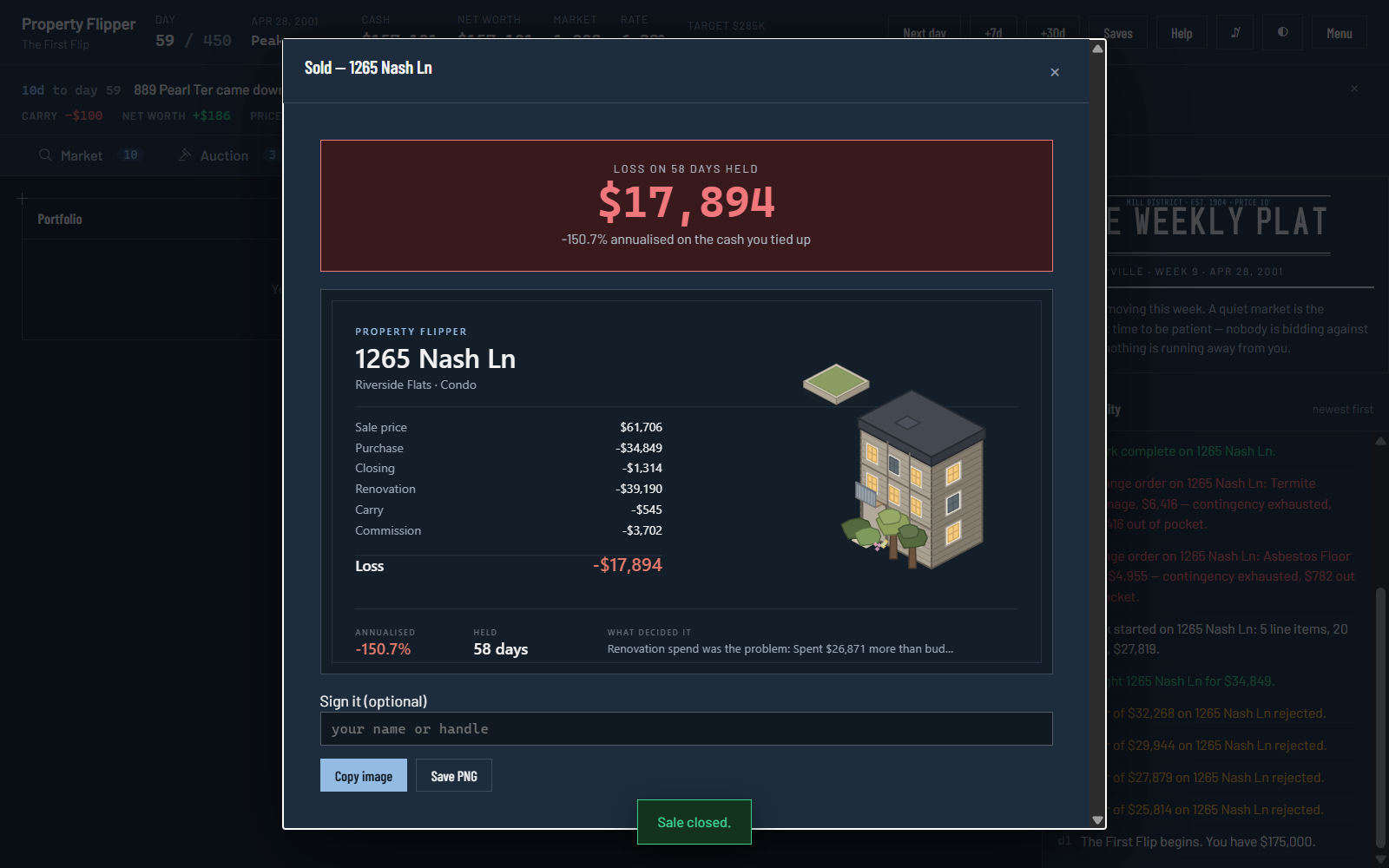
This one charges you for everything the real thing charges you for: 2% buying closing costs, 6% agent commission, points on the loan, and property tax, insurance and utilities every single day you own the house. Together those eat most of the 30% margin the industry’s 70% rule holds back — which is exactly what that rule is standing in for, and why it exists.
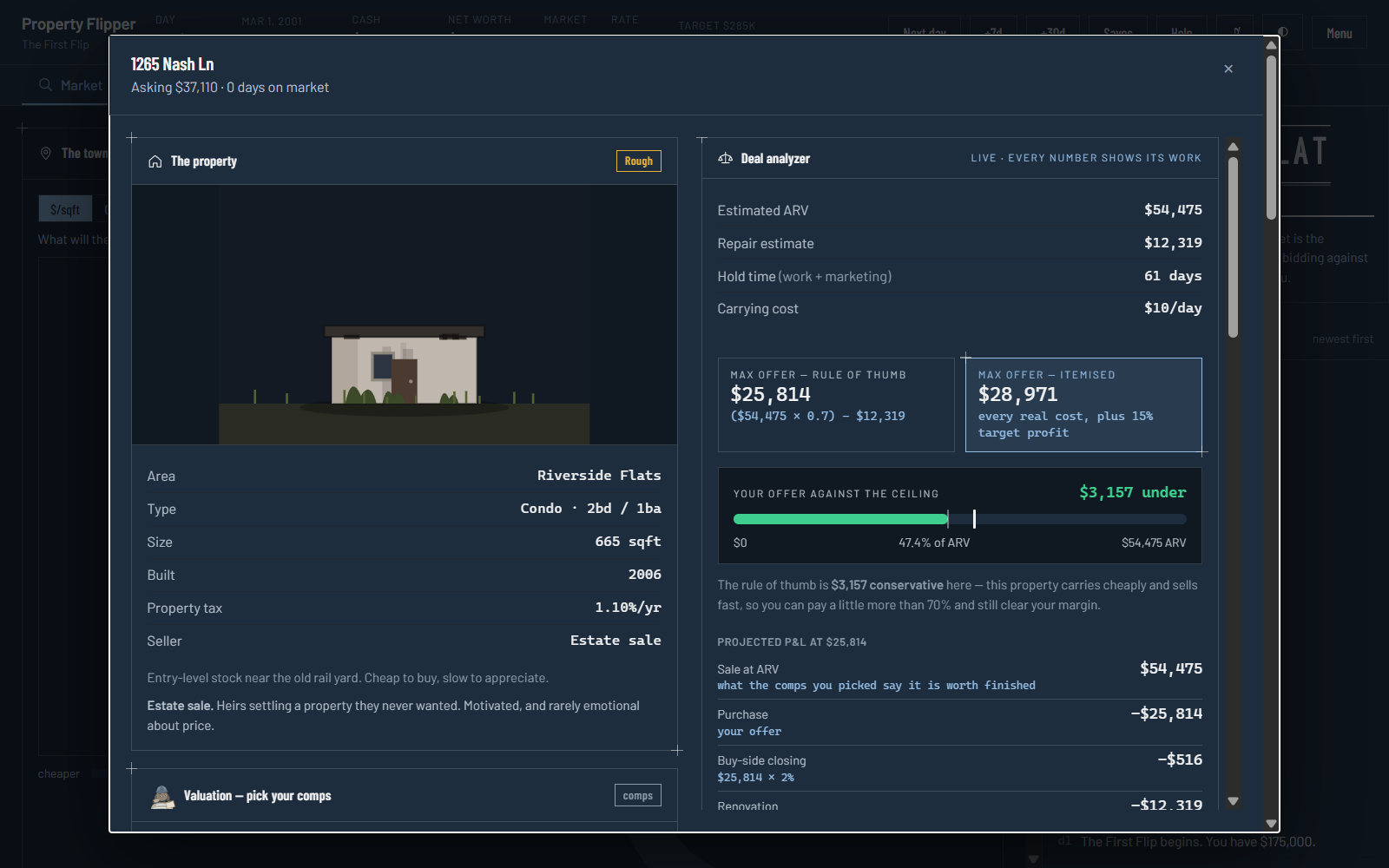
So the question the game asks is the one the job asks. What is the most you can pay for this house and still make money?
What you actually do
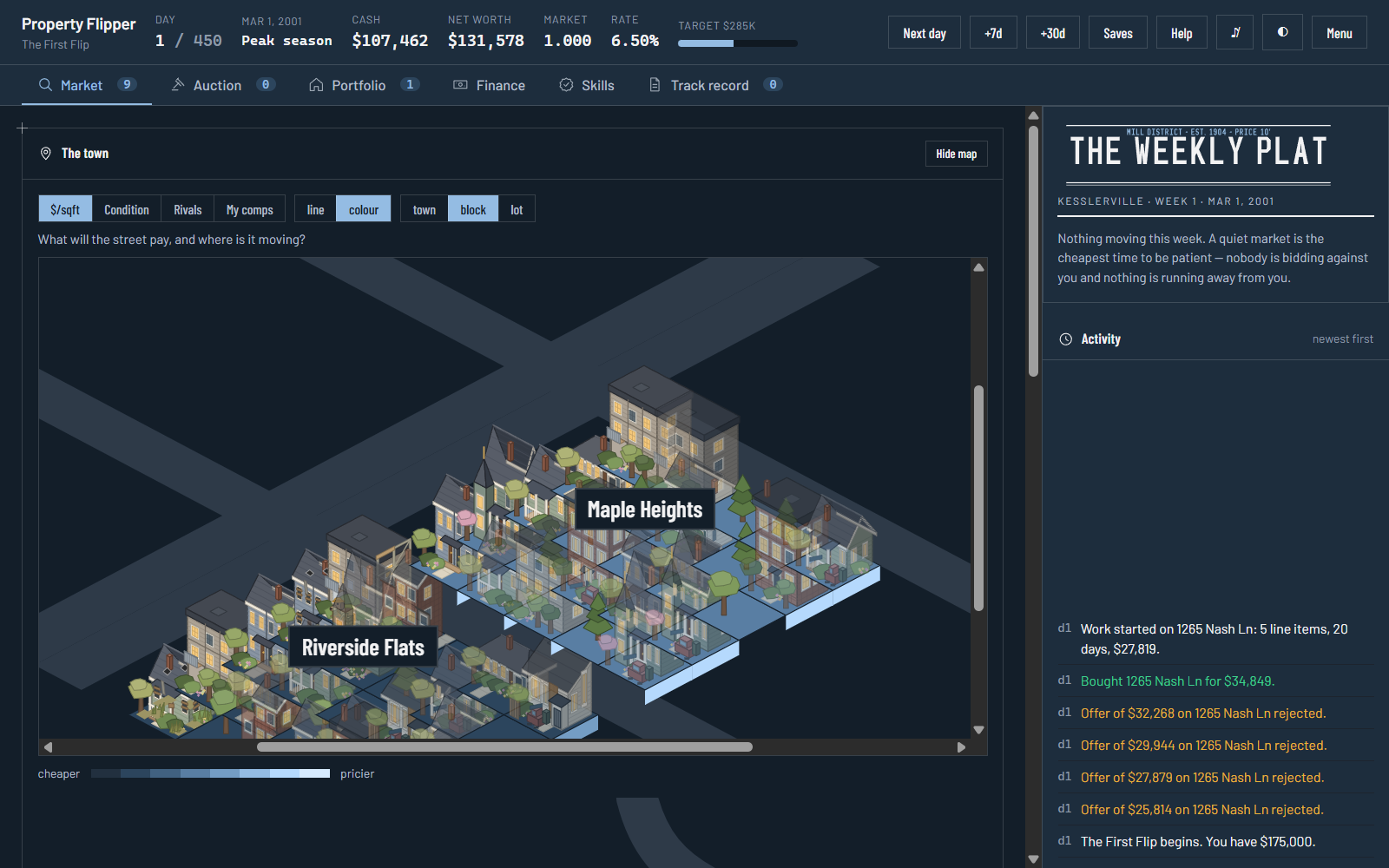
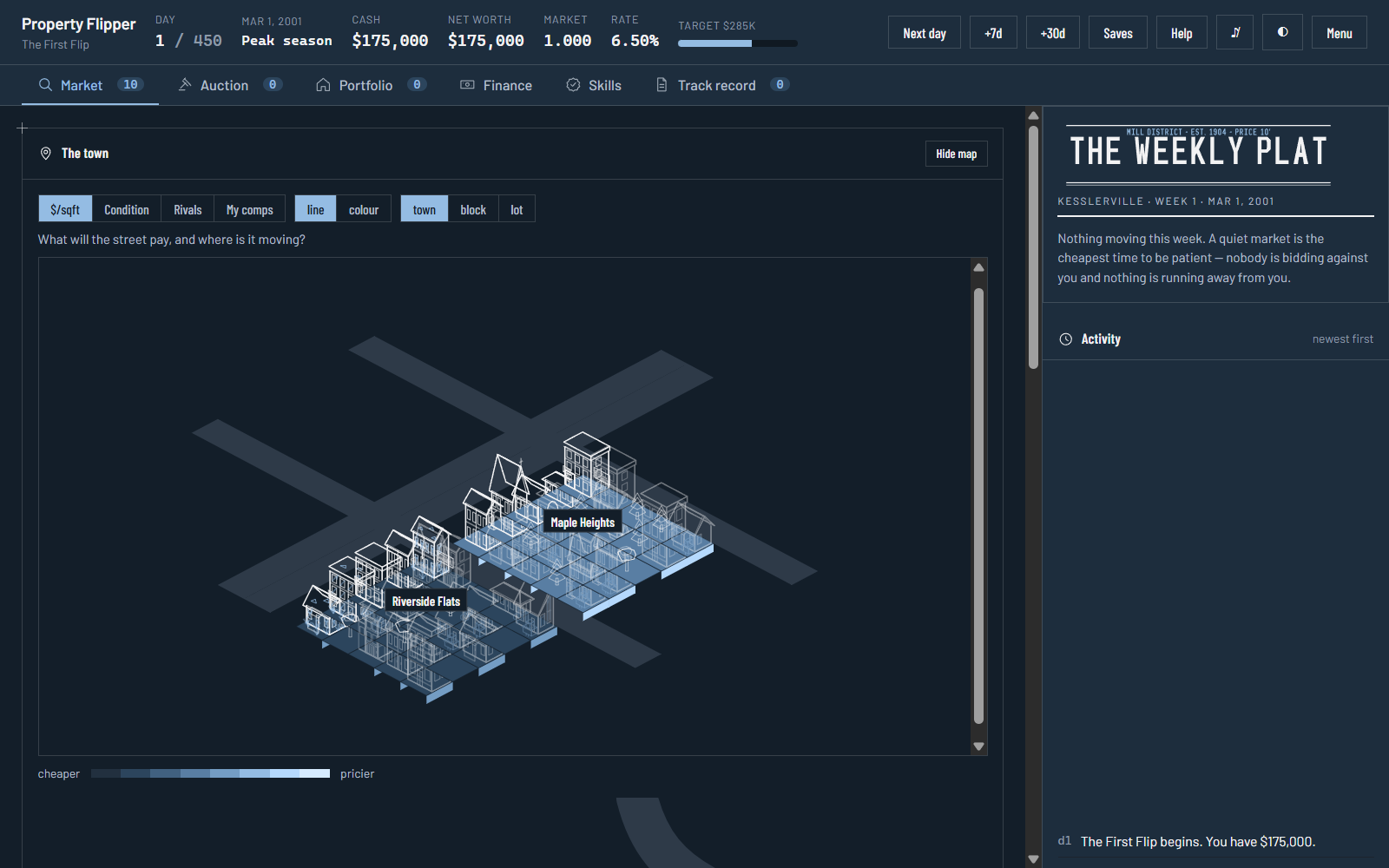
Screen the market. Every listing shows an asking price and your estimate of what it is worth. Those are different numbers, and the gap between them is not the deal — it is where the conversation starts.
Build a valuation you can defend. Pick your own comparable sales from a pool of seven. Every one is priced by the same model as the house you are buying, so leaning on a bigger house or a better street is wrong in a direction you could have predicted. Nothing adjusts for a mismatch on your behalf, and the error flows straight into your maximum offer.
Inspect before you offer. A standard inspection finds about 60% of what is wrong; a thorough one, 90%. Findings are disclosed to the seller, who has to concede most of the repair cost or lose the deal. That renegotiation is the entire economic reason due diligence exists — and skipping it costs about $32,000 a campaign, measured.
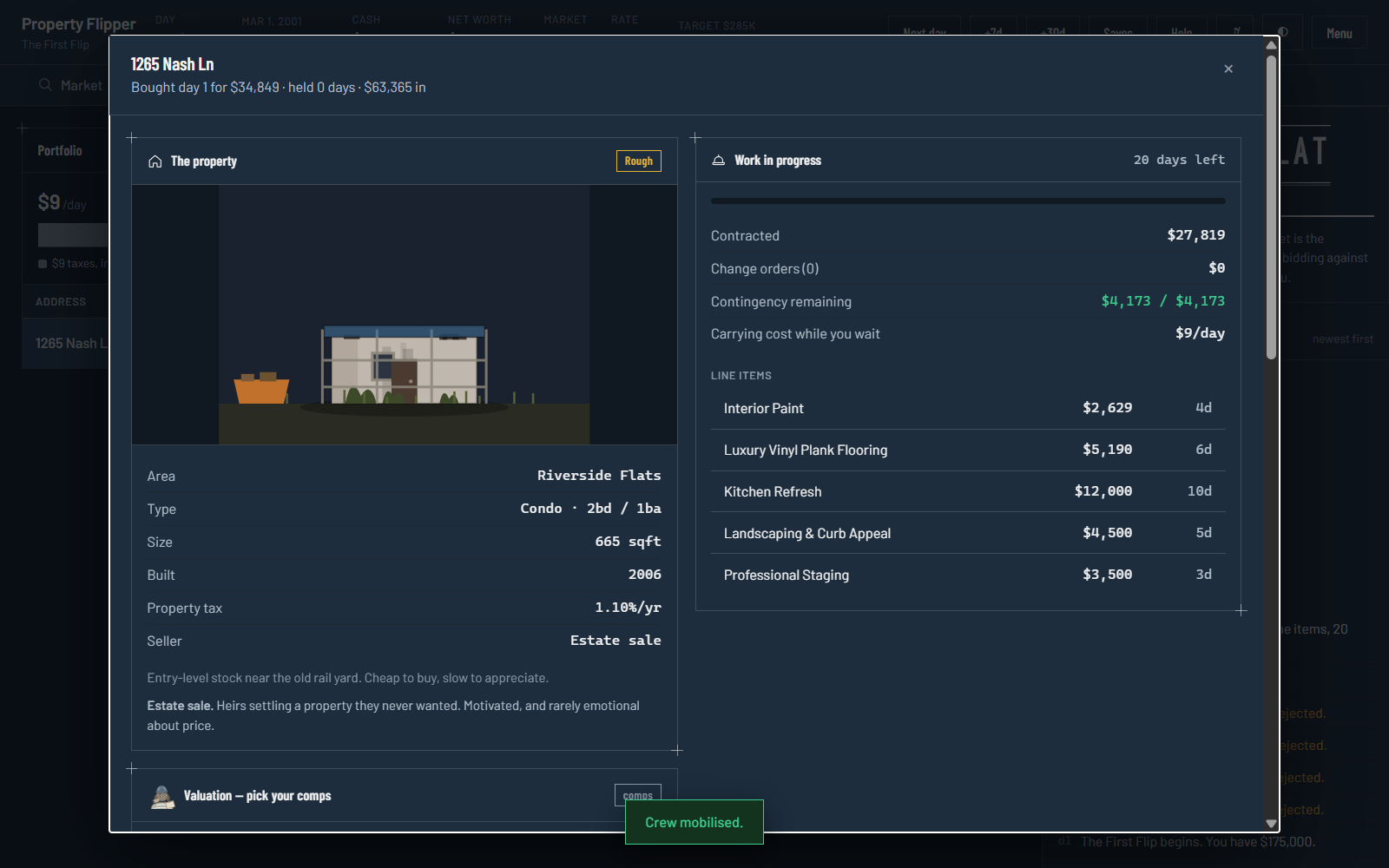
Scope the work and price the risk. Eighteen line items across eight categories. Set a contingency reserve; hidden defects surface as change orders against it once a crew opens the walls. Budget nothing and the first surprise comes out of the cash you needed for the rest of the job.
Sell — or don’t. List price drives buyer traffic off a cliff above true value. A financed buyer’s lender appraises the house, and the price falls to the appraisal when it comes in low, so the highest offer is not automatically the best one. Or keep it: put a tenant in, then refinance and pull your capital back out to buy the next one.
Five ways to buy, and none of them is free
- Cash. Nothing to service and nothing to default on. One deal at a time.
- Hard money. Fast, expensive, and the balloon does not care whether it sold.
- Private money. Cheaper — and nobody lends privately to a stranger. You have to earn it.
- Seller financing. The seller carries the note below market, and charges you on the price for doing it. Your price or my terms, not both.
- An equity partner. No interest, no maturity, nothing to default on — and a permanent third of the upside, with their capital coming back before yours.
And a fifth way in: the courthouse steps. Trustee sales open at what the lender is owed rather than what the house is worth. You cannot inspect, cannot finance, and about a third of lots still have somebody living in them.
What it teaches, honestly
Every number in this game is the number the industry uses. ARV, MAO, the 70% rule, cap rate, NOI, DSCR, cash-on-cash, LTV, seasoning, the appraisal gap. Nothing is a game-ified stand-in, and nothing is hidden behind a difficulty setting — difficulty changes how much room you have to be wrong, never what a deal is worth.
It is measured, too. A bot that follows the 70% rule, inspects before offering and reserves 15% contingency wins 72% of tutorial campaigns and ends with about $262,816. The same bot paying 92% of ARV wins 63% and ends with $218,515. That gap is the whole thesis, and it is checked on every commit across a hundred seeded campaigns.
There is also a Learn mode: five short scenarios, each isolating exactly one way a flip goes wrong.
Everything else
- Four campaigns and a sandbox, three difficulty settings, and a scenario editor that shares authored deals as a self-contained code
- Procedurally drawn houses that visibly decay and visibly recover, with known defects pinned to where they actually are
- Charts you can read with the keyboard, and a table under every one of them
- Neighborhoods that gentrify or decline over years, not weeks
- Seeded and deterministic: the same seed plays out the same way, and saves capture the random stream exactly
- Free, open source, no ads, no telemetry, no account, works offline
Play in the browser above, or download for Windows, macOS or Linux.
Download
Install instructions
Play in the browser: press the button above. Nothing to install, and saves live in your browser’s own storage.
Windows: the Setup .exe to install, or the Portable .exe to run without installing. These builds are unsigned, so SmartScreen warns on first launch — More info, then Run anyway.
macOS: open the .dmg and drag Property Flipper to Applications. Unsigned, so the first launch needs right-click → Open rather than a double-click.
Linux: download the .AppImage, chmod +x it, and run it. No dependencies.
Minimum: Windows 10 (1809+) 64-bit, macOS 11, or 64-bit Linux with glibc 2.28+. Any dual-core CPU, 4 GB RAM, 400 MB disk. No GPU requirement, no internet connection, no account.
Leave a comment
Log in with itch.io to leave a comment.